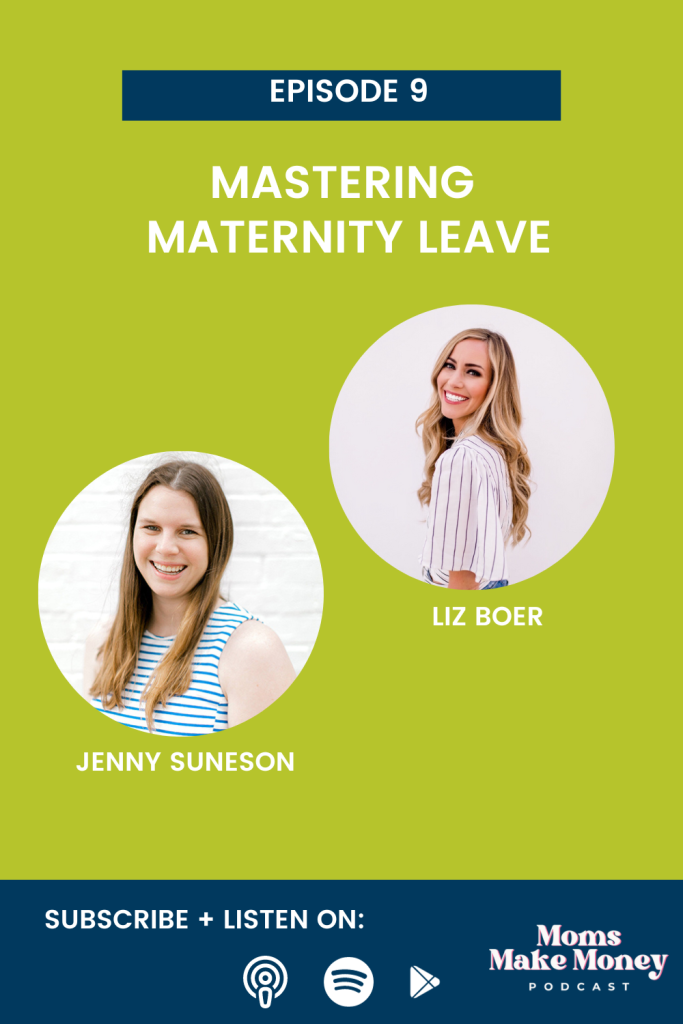
When you’re running your own business, maternity leave doesn’t come with a neatly outlined HR policy or a guaranteed paycheck. For moms building small businesses, the question isn’t if you’ll need maternity leave—it’s how to create one that supports both your growing family and your business.
In this episode of the Moms Make Money podcast, I sat down with entrepreneur and visibility strategist Liz Boer to talk about what maternity leave for small businesses really looks like—the planning, the mindset shifts, and the honest behind-the-scenes realities that come with transitioning into motherhood while running a company.
Why Small Business Owners Need a Real Maternity Leave
Too many women in business assume maternity leave won’t be a big deal. You picture yourself working during nap times, catching up on emails after bedtime, and jumping back into client work a few weeks after birth. But as Liz shared, reality looks very different.
Newborns don’t always nap as expected, postpartum recovery is no small thing, and even the most organized, Type-A entrepreneur quickly realizes that rest is non-negotiable. For small business owners, maternity leave isn’t about pressing pause on ambition—it’s about building systems and support so you can step away without your entire business falling apart.
Setting Up Your Business for Maternity Leave
Liz shared how she prepared her agency for a four-month leave by:
Wrapping up client projects in advance.
Setting clear expectations with retainer clients.
Arming her team with systems and processes so they could execute confidently while she was away.
Offering clients extra coaching calls and bonuses before she stepped back, so they felt cared for during her absence.
I took a different approach with my first leave—I stepped away for three months and let my team handle everything. That full rest helped me return with clarity and energy. This time around, I’m planning a shorter leave, but the holiday season will naturally lighten my workload.
The key takeaway? There’s no one “right” length for maternity leave for small businesses. What matters is preparing in advance and creating a plan that protects your time, your clients, and your income.
The Hard Truths About Coming Back
One of the biggest lessons Liz learned was that maternity leave doesn’t end when the calendar says it does. Transitioning back into work requires resetting priorities, adjusting expectations, and often restructuring your role.
She realized she didn’t want to be the main point of contact for her agency anymore. Instead, she shifted her role to focus on higher-level strategy and let her team handle client communication. That change not only gave her more margin as a mom but also created a stronger, more scalable business.
As moms, we often underestimate our own capacity postpartum. Physically, emotionally, and mentally, the first six months after birth can be draining. That’s why Liz cautions against jumping into new launches or major projects right after maternity leave. Instead, focus on easing back into business and stabilizing before you scale.
Preparing Beyond the Business
Planning maternity leave for small businesses isn’t just about client workflows and automation—it’s about life logistics, too. Liz shared that next time she’ll do more to prepare on the home front:
Prepping meals and household routines.
Clarifying who in the family handles what (laundry, groceries, meal prep).
Making space for her own self-care and mindset work.
These seemingly small details make an enormous difference in how supported and grounded you feel as you step back into business life.
Give Yourself Permission and Grace
Perhaps the most important lesson? Give yourself grace. Every baby, every leave, and every business is different. What worked once may not work the next time.
You don’t need to measure your success by how quickly you “bounce back.” Instead, ask yourself:
Am I giving myself enough rest?
Do I have systems in place so my business isn’t fully dependent on me?
Am I making time, even just five minutes, for myself each day?
Because when you take care of yourself, you’re not just protecting your business—you’re protecting your energy, your family, and your long-term ability to thrive.
Final Thoughts on Maternity Leave for Small Businesses
Taking maternity leave for small businesses isn’t easy, but it is possible. With the right systems, support, and mindset shifts, you can create a plan that allows you to step away, bond with your baby, and return to work without burning out.
If you’re preparing for your own maternity leave, start planning now. Map out your client needs, communicate openly, and don’t be afraid to lean on your team or community. Most of all, remember this: you’re not falling behind by stepping away. You’re building a business that works for your life—and that’s the true definition of success.
Master resell rights: The next big thing or just another form of MLM? On this episode of the Moms Make Money Podcast, I give my personal, no-BS take on master resell rights as the newest trend. Join me as I dive into what master resell rights are, why the internet is obsessed with them, and why I don’t think it’s the best move for entrepreneurs – especially moms.
Here’s the tea:
[01:54] The overnight obsession with master resell rights
[02:41] What master resale rights even are
[03:30] How the MRR craze got started
[04:15] Why master resell rights is trending
[06:09] The difference between master resell rights (MRR) and private label rights (PLR)
[07:28] Why I don’t think MRR makes sense (…like, at all)
[08:43] Where to find more info on MRR
[09:42] My final thoughts + how to keep the conversation going
The overnight obsession with master resell rights
I’ve been seeing reels and TikTok videos about master resell rights all over social media recently, and it wasn’t a slow building convo. It’s almost as if this obsession with MRR (master resell rights, not monthly recurring revenue – we love that) happened overnight.
No matter what platform I see it on, everyone seems to be pushing the same type of messaging to sell these opportunities. It also seems like people are going deep on the mom angle, telling moms that MRR is the easiest way to work from home. I believe this is a bold claim that isn’t necessarily true.
What master resell rights even are
What are master resell rights? Even though it gives me major MLM vibes, it’s not technically classified as an MLM. However, there is definitely some gray area and most of the people selling it are certainly making false income claims to try and rope people into purchasing access to their product. Having master resell rights enables you to sell the product, as well as the rights to resell that product, to others. So, you are taking someone’s product that they’ve created, and selling it to others. In turn, they also can turn around and sell it to others. This is part of what gives it such strong MLM vibes for me, since that chain just keeps going and going and going without end.
How the MRR craze got started
While doing my own research on master resell rights, I discovered the original founders of this method, Zach and Hannah Pippins. They initially created a course called The Roadmap to Riches, which they sell for somewhere around $497. They sell this course to their audience and then not only allow their audience to sell it to others, but allow them to resell it at 100% profit. That’s right – Hannah and Zach are only making profit from the people that actually purchase it directly from them.
Why master resell rights is trending
Why is the topic of master resell rights so big right now? In general, I think people are always looking for easy ways to make money online, as a side hustle or whatever that may be. As far as the timing goes in the United States, people as a whole are pretty vulnerable right now. The economy has not been great this year: groceries and other necessities have been super expensive.
To counter this, I think people are seeking any way to make money to help provide for their families, whether in addition to their 9-5 or if they’re going all in on this one thing. Honestly, it kind of makes me sad because these are the people I see being taken advantage of, and a lot of them are moms.
I think I feel this way about master resell rights because I created this brand because I genuinely want to help moms start businesses that are going to be sustainable long term. The trouble with trends like master resell rights is that they aren’t sustainable. Within three months (or less) of using the product, you’re not going to be making the same level of income that you were when you first started, and you’re going to feel defeated. You’re going to end up back at square one because this trend is going to fade into oblivion as the market becomes oversaturated.
This is another reason MRR gives me MLM vibes, because eventually you run out of people to sell to because people aren’t going to keep coming back to you to repurchase. They’re going to branch off and resell it to make profit for themselves.
The difference between master resell rights (MRR) and private label rights (PLR)
Now that you’ve been informed about master resell rights (MRR), I want to make sure you know the difference between that and PLR. PLR stands for private label rights. If you haven’t heard of PLR before, PLR enables you to perform any action with the purchased product without limitations, and you can also sell the product. The difference is that with PLR, you cannot allow people to resell these products. Once they purchase it from you, they can’t resell it. The ability to resell ends with you.
Why I don’t think MRR makes sense (…like, at all)
If you haven’t guessed by now, the idea of master resell rights model doesn’t really make that much sense to me as a business owner. The main reason this model feels really off to me is that you will inevitably have a non-existent buyer pool. As people continue the chain of buying and reselling, the market will become oversaturated. The person who initially buys from you moves immediately from customer status into selling status, and they don’t have to come back to you to repurchase.
One of my core values is really just being ethical. It’s really, really important to me. So this whole trend doesn’t sit right with me at all. It feels very predatory, scammy, and really unsustainable long term. I’m all about building a sustainable company, something that’s going to last forever and ever or until I decide I don’t want to do it anymore. If it’s something that might be really lucrative for three to six months but then die out? That’s a hard pass for me.
Where to find more info on MRR
if you’re listening in and thinking to yourself, Wow, this is super interesting, and you want to dive further into master resell rights. I highly recommend checking out the resources that I’ll be linking below. Build Your Tribe, with Chalene Johnson and her son, did an episode about it, and they’ve been in the online business space for a really long time.
Julie Chenell of Funnel Gorgeous did a lengthy Facebook post talking about it, and there are a lot of insightful comments there. I also found one from Hannah Alonzo on YouTube, where she talks about master resell rights in more depth than I do in this episode. So if you want to dive into more about MRR, definitely check those resources out.
My final thoughts + how to keep the conversation going
I’m not going to pretend like I’m pro and I know everything about MRR, but after seeing it blow up on social media I wanted to do my own research and talk with you about why I don’t think it’s the right move for moms in business. I would love to know if you’ve seen it on social media as much as I have. If you have, what are your thoughts on it?
For me, I find it very weird that everyone’s bio is essentially the same if they’re marketing on Instagram. It’s like a red flag you can see from miles away. I’d love to know your thoughts on it if you’ve seen it. If you’ve never seen it before, and you’re intrigued, let me know because I always love diving deep into stuff like this.
Either way, let me know over on Instagram, my handle is @MomsMakeMoneyCollective. I always love chatting with you guys in the DMs, especially about stuff like this because I love to know that I’m not the only one fascinated by it.
As moms, we start our businesses for freedom and flexibility. But somewhere along the way—between the nap-time hustles, the client deadlines, and the never-ending to-do lists—we can forget why we started in the first place.
In this episode of the Moms Make Money podcast, I sat down with Michelle Pontvert, a life-first business strategist and educator, to talk about how we can intentionally design businesses that support our lives, not the other way around. Michelle is also the co-host of Marketing Like a Mother, co-owner of the Like a Mother Movement, and the creator of the Business Chic Shop. Oh, and she’s also a mom raising a high-needs child while juggling multiple businesses.
This conversation was exactly what I needed as I prepare for baby #2 and the return to the unpredictable chaos of working from home with a newborn. Michelle reminded me (and now I’m reminding you): our businesses should fit around our lives, not consume them.
The Beauty of Building a Business With a Partner
Michelle and I bonded over being multi-passionate entrepreneurs with joint ventures. She runs her solo business while also co-owning the Like a Mother Movement with her business bestie Olivia.
Here’s what I loved from her perspective:
Having a business partner means you can pick your group project partner—and actually choose someone whose skills complement yours.
Splitting roles based on energy and strengths (Michelle handles tech and design, Olivia manages copy and customer service) keeps things sustainable.
Business is more fun when you don’t have to do it all alone.
If you’re a multi-passionate entrepreneur, a partnership might be the key to turning those shiny new ideas into reality without burning out.
Elastic Planning: Running a Life-First Business
When I asked Michelle what her weekly schedule looks like, she laughed and admitted it changes constantly. With a child who has extra therapies and unpredictable needs, planning in the traditional sense doesn’t work for her.
Instead, she created a method she calls Elastic Planning—a way of holding space for projects while leaving room for flexibility.
Here are some of her strategies you can borrow:
Use tools like the Eisenhower Matrix to separate the urgent from the important.
Start with the fun tasks first to build momentum (“dessert before dinner” as she calls it).
Allow creativity to flow even when you’re not at your desk—brainstorming and ideating still move your business forward.
Accept that some weeks you’ll have 20 hours to work, and others you’ll only have two.
As moms, our schedules aren’t always ours to control. Elastic planning reminds us that progress still counts, even if it doesn’t look “consistent” on paper.
When Life Forces You to Pivot
Michelle shared candidly about hitting burnout in client services. Instead of phasing out slowly, she burned it down and rebuilt her business around digital products and affiliate marketing.
It wasn’t the “safe” way, and yes, her income dipped for a while. But eventually, it led to:
More happiness and less stress.
Offers that worked with her brain and lifestyle.
A business that was sustainable long-term.
Her story is a powerful reminder that you’re allowed to pivot fast if slow isn’t working.
Flexibility During Sick Days and Seasons of Chaos
If you’ve ever had a toddler in daycare, you know the drill: constant colds, surprise fevers, and endless rescheduling. Michelle has lived through months of sickness where she and her son were alternating being sick for weeks on end.
Her advice for handling it:
Lower your capacity expectations. Don’t sign yourself up for rigid deadlines during seasons you know will be unpredictable.
Communicate upfront. Let clients, collaborators, or podcast guests know you’re a parent and flexibility might be needed.
Add caveats to contracts. Build in clauses for rescheduling or unexpected delays.
Show gratitude. When clients are flexible, acknowledge it and even surprise them with a little bonus or add-on.
The key? Stop pretending life won’t interfere with business. Plan for it instead.
Boundaries, Burnout, and Putting Yourself Back on the List
Michelle and I both confessed that as moms, we often put ourselves last—behind kids, clients, and even our husbands. But when we do that, burnout is inevitable.
Some takeaways from this part of the conversation:
Boundaries are only respected if you communicate them clearly (and more than once).
Contracts are essential—don’t DIY them and hope for the best.
Self-care doesn’t have to mean bubble baths; sometimes it’s just white space and quiet.
You can’t be a present, patient mom if your own cup is empty.
This hit home for me because I realized I’d let a lot of my boundaries slip since my son started school. With a newborn on the way, I need to scale back and protect my energy again.
Michelle’s #1 Tip for Moms Starting a Business
When I asked Michelle for her best advice for moms ready to dive into entrepreneurship, her answer was simple but profound:
👉 Start with YOU.
Before you choose a business model, service, or offer, ask yourself:
What do I want my days to look like?
What kind of work actually excites me?
How much time and energy do I realistically have?
What systems and structures suit my brain and my life?
Too often, we build businesses that look good on Instagram but don’t actually work for our lives. Michelle challenges us to flip that script—build the business that works for you first, then layer in the strategy.
Final Thoughts
Talking with Michelle was a powerful reminder that building a business as a mom doesn’t have to mean hustle, burnout, and guilt. It can mean flexibility, joy, and fulfillment—if we intentionally design it that way.
As I prepare for my own season of transition into newborn life again, I’m taking Michelle’s advice to heart: life comes first, business second. And when I lead with that, both my family and my business thrive.
In today’s episode, Jenny sits down with Jess Marshall, a women’s hormone health coach who helps women balance and support their hormones using sustainable habits.
Join Jenny and Jess as they discuss ways to harness the power of cycle syncing for better productivity and overall well-being, diving deep into the different cycle phases and revealing how these phases impact our bodies and minds. Listen in for tips on how to incorporate exercise, nutrition, and syncing habits to optimize energy levels, balance hormones, and improve our lives.
We discuss:
[02:32] The what and why of ‘cycle syncing’
[05:13] Postpartum, perimenopause, and irregular cycle syncing
[09:52] How to get started and the benefits of cycle syncing
[13:20] What to consider when picking an app to track your cycle
[15:35] The first distinct cycle phase plus nutrition and exercise tips
[21:06] How to find balance in life and business during the follicular phase
[28:13] Navigating the ovulation phase for better business moves and hormone health
[32:09] Preventing burnout and managing PMS symptoms in the luteal phase
[39:42] The benefits of running your own business while cycle syncing
[40:53] Jess’s number 1 tip for mom’s looking to start or grow their business
[42:31] Ways to connect with Jess Marshall
The what and why of ‘cycle syncing’
The simplest way to think of cycle syncing is to think of it as adjusting your habits in the areas of self-care activities such as nutrition and exercise as well as work tasks and social obligations. When you begin to adjust those habits according to the four distinct phases of your menstrual cycle, you start to feel the benefits: more energy, more effective workouts, less PMS symptoms, and more. You also start to feel less burn out because you are working with your body and hormones and not against them, like a lot of popular diets or super intense workout programs are actually doing. When you begin to sync your cycle and experience the benefits of practicing cycle syncing, it leads to a higher rate of consistency of your habits.
Postpartum, perimenopause, and irregular cycle syncing
If you’ve ever wondered who would benefit from cycle syncing, Jess makes it clear that she recommends the practice for any menstruating woman.
If you’re a new mom, you can begin to practice cycle syncing as you move out of your fourth trimester. If you don’t quite have your cycle back, Jess suggests syncing your habits with the moon phases. As a science-minded person, Jess mentions that this is as ‘woo-woo’ as she gets, but that she has actually personally reaped the benefits of syncing her own habits with moon phases during times her cycle was irregular. If you decide to try sinking with the moon phases, try treating each New Moon like day one of your menstrual cycle. An easy way to remember that is to think, New Moon, new cycle. Then, every full moon would signal your ovulation day. The timing works out really well, so moon cycles match up really well with the “average menstrual cycle.” If you have unpredictable cycles, either because of a hormone imbalance, perimenopause, or any other reason, and your cycles aren’t as predictable, you can use the moon phases for that as well.
It’s important to mention that if you don’t know exactly why your cycles are irregular, that’s definitely something to get some help with and get checked out. Irregular cycles without an obvious cause is your body’s way of telling you that something is off with your hormones.
How to get started and the benefits of cycle syncing
The first step of cycle syncing is to start tracking your menstrual cycle. If you’re not tracking it yet, start tracking every single day and not just your period days. It’s important to track things like your energy levels, cravings, mood swings, sleep patterns, bathroom habits, brain fog, acne, bloating and gas, any sort of breast tenderness or pain, headaches, joint pain, and how you felt during your workouts that day. Your experience with those symptoms affect more than just your menstrual cycle, so being able to notice any ongoing patterns is extremely beneficial.
Once you start tracking and have a good feel for what your normal cycle is, because everyone is different, your next step would be to choose one or two small habits to start adjusting around your cycle. Keep in mind you don’t need to completely overhaul your life overnight.
You may begin to notice changes fairly quickly, even within your first cycle. You’ll begin to feel more energy, wake up more refreshed, or maybe your period was just a little bit easier. For most women, Jess states changes begin to become more apparent after the 3 month mark, since hormones are typically on a 90 day pattern.
What to consider when picking an app to track your cycle
There are quite a few apps out there that can help you track your cycle and it can become pretty overwhelming. Jess stresses that you shouldn’t spend too much time worrying about which app is the “best,” because different apps will work better for different women. For example, Jenny uses an app called Glow, which offers a free version to users. Jess uses an app called Wild AI, which is geared toward women who are actively exercising and offers a wide variety of tracking features and gives suggestions on how to adjust your exercise and nutrition through the cycle.
Search for an app on your phone, pick one that feels right for you, and then get started!
The first distinct cycle phase plus nutrition and exercise tips
Phase one of your cycle is called the menstruation phase, which is considered day one of your period, the first day of actual bleeding. If you’re one of the many women that tend to have spotting a few days before your actual flow starts, keep in mind that the days of spotting don’t count as the beginning of the menstruation phase. The phase begins the first day you have blood flow. This phase typically lasts between three to seven days. During this phase, estrogen and progesterone are at the lowest point of the whole cycle, so you might notice that you’re experiencing lower energy levels and don’t feel very social. Try not to over commit to a bunch of social obligations during this phase if you can help it. Instead, prioritize activities that really fill your cup up,
With exercise, try to keep it gentle during the menstruation phase, especially if symptoms bother you.
With nutrition in the menstruation phase, focus on getting an adequate amount of omega three fatty acids, zinc, iron, and protein. Some great foods to have during this phase include foods like walnuts, avocados, coconut oil, spinach, kale, fatty fish, pumpkin seeds, eggs, beef, flax seeds, and lentils. Make sure that you are pairing those iron rich foods like spinach with foods with vitamin C to help with absorption, and avoid a lot of caffeine, alcohol, and anything with a lot of sugar because those can add to the inflammation and increase some of your symptoms like cramping.
For the business side of things, your menstruation phase is a really good time for reflection, inner work, and general self-improvement. Try some of the back end planning since you might not be feeling the most social or outgoing in this phase, and avoid front facing camera stuff or anything that puts you under the spotlight..
How to find balance in life and business during the follicular phase
Phase two is the follicular phase. The length of this phase can vary from woman to woman and is often what determines the length of your entire menstrual cycle. During this phase, estrogen starts to rise in preparation of ovulation. You’ll typically feel more energy, your body is more resilient to stress, and you can handle a little bit less sleep, although that doesn’t mean anyone is suggesting you use that as an excuse to purposely over-do anything. Women typically experience a decrease in metabolism during this phase and are more sensitive to insulin as well, which means you’re less prone to blood sugar swings.
For exercise during the follicular phase, your body can handle higher intensities due to the rising of estrogen. It’s a great time to lift heavier weights, and try higher intensity workouts. Your body is primed to build muscle and recover better during this phase.
For nutrition, you want to focus on what’s called cruciferous vegetables, like broccoli, brussel sprouts, and kale. These vegetables have something in them called DIM, which helps remove excess estrogen from your body. Once your body is finished with the estrogen that it has used, you don’t want it to stick around in your body otherwise it can lead to something called estrogen dominance, which can lead to a whole slew of unwanted symptoms.
The follicular phase is a great time for being creative in your business. Make time for creating or brainstorming, like planning a new program, writing blog posts or social media content, or batch recording. You’re likely to feel more outgoing in this phase, so it’s a great phase to try new or more social things.
Navigating the ovulation phase for better business moves and hormone health
The third and shortest phase of your menstrual cycle is the ovulation phase. Although it’s the shortest, it’s actually the most important phase of the entire cycle. Ovulation is essential for your body to produce hormones, so if you’re not ovulating regularly, it’s really hard for your body to have optimal hormone health. During ovulation, you might experience having higher energy and libido levels and slightly lower immunity.
During the ovulation phase, try higher intensity workouts if that’s what you enjoy doing. It’s important to note that your joint laxity may also be increasing during this phase, which slightly increases your risk of injury, so pay extra attention to be sure you’re using proper form and that you’re warming up appropriately.
Similar to the follicular phase, be sure to eat cruciferous vegetables like broccoli, kale, brussel sprouts, and foods high in fiber to help your body rid itself of that estrogen. Add in magnesium rich foods like dark leafy greens, seaweed, almonds, avocado, pumpkin and flax seeds and foods rich in zinc like dark chocolate.
You’re likely to feel more social and outgoing during this phase, so business-wise it’s a great time to really focus on productivity, big projects, big launches, speaking engagements, or anything you need to record like videos or podcasts.
Preventing burnout and managing PMS symptoms in the luteal phase
The last phase of your menstrual cycle is called the luteal phase.This phase can be anywhere between 11 to 17 days long. During this phase, your energy might start to decrease, though your metabolism and appetite will begin to increase. You may also notice other PMS symptoms like fatigue or mood swings.
During the luteal phase for exercise, because of the higher levels of progesterone during this phase, it is a little bit harder for your body to make and maintain muscle. Pushing it super hard during this phase won’t really help you to move forward in any of your exercise or fitness goals, so focus on medium to lower intensity endurance cardio.
When it comes to nutrition during the luteal phase, focus on healthy fats to help with progesterone production, incorporating foods like avocado, fatty fish, olive oil, nuts, and seeds. Also be sure to include foods that are high in Vitamin B6. With your body being more prone to blood sugar spikes and crashes, you want to pay extra attention to eating balanced meals.
When it comes to business, the luteal phase is a great time for cleaning and organizing some of those back-end business tasks. It’s the perfect time for planning, budgeting, and decision making, though Jess suggests not taking action on decisions during this phase. Delegate what you can and avoid large projects during this phase.
The benefits of running your own business while cycle syncing
When you run your own business, you’re in charge of your schedule, unlike in the corporate world where everything is typically dictated for you. When you have the power and flexibility to create and change the schedule, it makes developing different habits to support your hormones that much easier because there aren’t as many obstacles in your way.
Jess’s number 1 tip for mom’s looking to start or grow their business
When asked what her number 1 tip for mom’s growing a business would be, Jess wanted to stress the importance of building a business that works for you, your life, and your priorities. Understand that things may shift as you move through different chapters of your life, and don’t compare yourself to other business owners because none of them are experiencing the exact same life and situation as you.
As a mom entrepreneur, you already know how challenging it is to juggle business ownership and motherhood. But when you add a new baby into the mix, that balancing act becomes even more demanding. That’s why maternity leave isn’t just a nice-to-have—it’s essential.
I’ve seen far too many moms sending client emails while in labor or rushing back to work days after giving birth, only to regret it later. The truth is, skipping or shortening your maternity leave often leads to burnout, resentment, and missed bonding time you can’t get back.
Today, I want to share why it is so important for moms in business, my own experience with taking time off, and how planning ahead can make the process smoother for both you and your business.
My First Maternity Leave as a Business Owner
In 2020, I experienced my first maternity leave as a self-employed business owner. I planned every detail—bringing on support for my clients, hiring a temporary Online Business Manager, and setting up systems so my inbox wouldn’t explode while I was gone.
Was it easy to step away? Not at all. But giving myself three full months of maternity leave was one of the best decisions I’ve ever made. It allowed me to focus on the steep learning curve of becoming a mom, recover from an unexpected C-section, and simply be present without my brain constantly toggling between diapers and deadlines.
That break gave me the energy and clarity I needed to return to my business refreshed and full of new ideas.
Why Maternity Leave Matters for Mom Entrepreneurs
Taking maternity leave as a business owner comes with countless benefits—for your health, your family, and even your business. Here are some of the biggest ones:
1. Focus on Recovery and Wellbeing
Childbirth is physically and emotionally demanding, no matter what kind of birth you have. Maternity leave gives you the time and space to heal, regulate postpartum hormones, and prioritize your mental health.
2. Prioritize Family Without Guilt
When you step away from business temporarily, you give yourself permission to fully focus on your new baby and your family. You won’t feel torn between client deadlines and feeding schedules—you can just be there.
3. Reduce Stress and Prevent Burnout
Let’s be real: newborn life is exhausting. Between sleepless nights, recovery, and adjusting to your new normal, trying to run your business at full speed is a recipe for burnout. Maternity leave relieves some of that pressure.
4. Bond With Your Baby
Those early weeks are crucial for bonding and attachment. Taking maternity leave allows you to soak in those irreplaceable moments and build a foundation with your baby without the constant pull of your business.
5. Come Back With Renewed Energy
Stepping away for maternity leave often provides fresh perspective. Many moms, myself included, come back to their business with renewed clarity, fresh ideas, and even stronger leadership skills.
6. Empower Your Team
If you have a VA, OBM, or even just one contractor, maternity leave forces you to delegate and empower others. This builds confidence in your team, strengthens your systems, and proves your business can run without you.
Planning Your Maternity Leave
The key to a smooth maternity leave is planning ahead. A few steps to consider:
Communicate early with clients and team members about your timeline.
Delegate responsibilities so that nothing falls through the cracks.
Set boundaries for emergencies only (I had a special Slack “SOS” channel, which, fun fact, never got used).
Create systems like SOPs or FAQs to reduce unnecessary questions while you’re out.
It’s also important to set your own expectations. Your leave doesn’t have to look like anyone else’s—it could be six weeks, three months, or more. What matters is that you give yourself the space to heal, adjust, and step into your new role as a mom (again).
Modeling the Importance of Maternity Leave
As business owners, the way we handle this time off sets an example—not just for our clients, but for our teams too. If you value work-life balance and family, your team will feel more empowered to do the same.
I currently have multiple contractors who are also on maternity leave, and I always encourage them to take at least a month off, minimum. Leading by example matters, and I couldn’t preach the importance of maternity leave if I wasn’t willing to take it myself.
Final Thoughts
Taking an extended leave as a business owner may feel scary, but it’s one of the best decisions you can make—for your health, your family, and your business. By planning ahead and giving yourself permission to step away, you’ll return stronger, clearer, and ready to serve your clients at an even higher level.
So mama, if you’re expecting, I urge you: take the maternity leave. Give yourself that time. You and your business will be better for it.
👉 I’d love to hear from you—did you take a maternity leave as a business owner? How long did you take, and how did it impact your business? Send me a DM on Instagram @momsmakemoneycollective—I’d love to chat about your experience!
Being a mom entrepreneur comes with its own unique set of challenges—and opportunities. You’re balancing nap schedules with client calls, snack requests with content creation, and still trying to carve out time for yourself. It can feel overwhelming, but here’s the truth: you don’t need a massive budget, fancy tools, or a perfectly curated plan to succeed.
What you do need are four core essentials that will help you thrive in both business and motherhood. These essentials will ground you, keep you moving forward, and remind you why you started this journey in the first place.
1. A Plan (But Not a Perfect One)
Every mom entrepreneur needs a plan, but don’t overcomplicate it. You don’t need a 50-page business document—just a clear direction to guide you. Think of it as your roadmap.
Ask yourself:
What services or products do I want to offer?
How many hours can I realistically work each week?
What platforms feel good for me to show up on?
What’s my income goal for this season of life?
Having even a simple plan in place gives you clarity and momentum. It also prevents you from spinning your wheels or getting stuck in busywork.
💡 Pro tip for mom entrepreneurs: Start with something you can offer right away, like a small service package or a digital product. Cash flow matters, and you can always refine and expand later.
2. Flexibility
If there’s one thing a mom entrepreneur needs to master, it’s flexibility. Kids get sick, naps end early, and meltdowns happen at the worst possible times. Even with childcare, unexpected situations can throw your schedule off.
When my son first started daycare, I quickly realized that I couldn’t count on a consistent work schedule. There were weeks when he was home sick more than he was at school. That’s when flexibility became my best friend.
Sometimes this means working during naps, evenings, or weekends. It’s not forever—it’s just the season you’re in right now.
💡 Pro tip for mom entrepreneurs: Build at least one offer that doesn’t rely on live calls or set hours—like a digital download, workshop replay, or template shop. This ensures you can keep earning even when life gets unpredictable.
3. Determination
As a mom entrepreneur, determination is what keeps you moving forward on the hard days. And trust me—there will be hard days. Days when the baby won’t nap, when your toddler needs you constantly, or when you’re simply exhausted.
What separates successful mom entrepreneurs from those who give up isn’t luck—it’s determination. They commit to their vision, even when it feels messy, slow, or frustrating.
💡 Pro tip for mom entrepreneurs: Surround yourself with accountability. Whether it’s a mentor, mastermind, or biz bestie, having support helps you stay determined when motivation runs low.
4. Patience
Patience is the secret weapon of every successful mom entrepreneur. Building a business while raising kids is a marathon, not a sprint. Some days you’ll only have 30 minutes to work—and that’s okay. Those small steps add up over time.
Remember, this season of motherhood won’t last forever. The long nights and unpredictable schedules are temporary. By giving yourself grace and practicing patience, you’ll avoid burnout and actually enjoy the journey.
💡 Pro tip for mom entrepreneurs: Set small, realistic goals that fit your season. Instead of aiming for six figures right away, focus on landing your first few clients or selling your first 10 digital products.
Final Thoughts
Being a mom entrepreneur is not about doing everything perfectly—it’s about doing what you can, when you can, with consistency and heart. With a plan, flexibility, determination, and patience, you can build a thriving business while raising your little ones.
Most importantly, remember this: every mom entrepreneur’s journey looks different. Give yourself grace, embrace your unique season, and keep going. Your kids are watching, and you’re showing them what’s possible.
👉 Want more support as a mom entrepreneur? Join the Moms Make Money Collective where you’ll find strategies, tools, and a community of moms building businesses in the margins of motherhood.
As moms, we’re constantly balancing a million things—family, house, maybe even a traditional 9–5. But what if you could create income from home that actually fits into your life (and doesn’t involve selling leggings or protein shakes to your friends)?
That’s exactly what today’s conversation is all about. Inside this episode, I’m breaking down nine ways for moms to make money from home without going the MLM route. These are options you can start small, grow over time, and shape into a business that works for your family.
1. Become a Virtual Assistant
One of the most popular and flexible ways for moms to make money from home is by becoming a virtual assistant (VA). This is actually where my journey started, and I truly believe it’s one of the best entry points into online business.
As a VA, you can offer support in almost anything—admin tasks, customer service, bookkeeping, social media management, and more. You don’t need a huge audience to get started. You just need one client who needs your help. From there, you can build skills, get referrals, and even pivot into more specialized work.
2. Start Freelancing
Another in-demand option is freelancing. Think:
Graphic or web design
Copywriting
Social media strategy
Email marketing
Freelancing is slightly different from VA work because it positions you as the expert. Instead of executing tasks from a client’s to-do list, you take the reins and deliver high-quality results. If you’ve got a skillset from your past work experience, freelancing is one of the best ways for moms to make money from home quickly.
3. Explore Influencer Work
Love creating content and showing up online? Influencer work could be a fit. Whether through blogging, Instagram, TikTok, or YouTube, you can partner with brands and get paid to create content.
The reality check? Influencer work takes time, consistency, and creativity. It’s not usually an overnight success story. But for moms who enjoy writing, filming, or photography, it can be a fun and profitable way to earn money while staying home with your kids.
4. Try Coaching or Consulting
Do you have skills from a past career that other people would pay to learn? Maybe you’re into health and wellness, or maybe you’ve spent years in marketing or project management.
Coaching and consulting let you package that knowledge into a service. Just know that while it’s a fantastic path, it often requires building a larger audience first. Many moms start with services (like VA or freelance work) and then transition into coaching once they’ve built up credibility.
5. Create an Online Course
Digital courses are another great option, especially for moms who want to scale without trading time for money. But like coaching, you’ll need an audience and a proven process before jumping in.
One smart path? Start by offering 1:1 services, then create a course teaching your proven system. That way, you’re not starting from scratch—you’re leveraging what already works.
6. Offer UGC (User Generated Content)
If you love creating content but don’t want the pressure of growing your own following, UGC (user generated content) is worth exploring.
Brands pay you to create photos or videos they can post on their own platforms. You don’t need an audience—just creativity. For moms who like filming, editing, or photography, UGC is one of the most accessible ways to make money from home right now.
7. Start an E-Commerce Shop
E-commerce is a huge opportunity for moms. You can open an Etsy shop, a Shopify store, or even sell directly through your website. Options include:
Digital products (like templates, planners, or printables)
Physical products (boutique clothing, handmade items, home goods)
PLR (private label rights) products you rebrand and resell
This is one of the most scalable ways for moms to make money from home, especially if you love creating products or curating items to sell.
8. Try Reselling
If you’re the type who loves thrifting or finding hidden gems, reselling might be the perfect fit. Moms are making income by flipping items they find at thrift stores, online marketplaces, or even limited-edition brand drops.
It’s not the most predictable way to make money, but it can be fun and flexible—perfect for moms who enjoy shopping and want a side hustle they can grow over time.
9. Mix and Match Your Income Streams
Here’s the truth: you don’t have to choose just one of these options. Many moms (myself included) combine multiple streams of income. For example, you might start with VA services, add in a digital product, and later branch into e-commerce.
This flexibility is one of the biggest benefits of working online. You can test, pivot, and evolve as your family’s needs change.
Final Thoughts
There are so many ways for moms to make money from home without falling into an MLM. The best option is the one that fits your skills, interests, and season of life.
👉 Which option excites you the most? Come hang out with me on Instagram @momsmakemoneycollective and let’s chat!
And if you’re craving a supportive community, join us inside the free Moms Make Money Collective Facebook group. You don’t have to figure this out alone.
Running a business while raising a family isn’t for the faint of heart, but it’s also one of the most rewarding paths you can take. On the Moms Make Money podcast, I share what it really looks like to balance motherhood and entrepreneurship.
In this episode, I’m pulling back the curtain on how I went from being an exhausted social media manager to building and leading a podcast production company that supports both my clients and my family life.
How It All Began
Back in the summer of 2016, I started my first business, Confetti Social. At the time, I was juggling grad school, planning my wedding, and working full-time in a corporate marketing job that left me feeling unfulfilled. Out of curiosity (and a desire for something more meaningful), I offered my first Pinterest setup service for just $50.
That small step turned into Pinterest and Instagram management services, with my first clients coming from simple Facebook group posts. Before long, I was booked out and ready to leave my corporate job for good.
But even then, I knew social media management wasn’t the most sustainable long-term fit for my goals. That’s when podcasting entered the picture.
The First Big Pivot
In January 2018, I launched my first podcast, The Savvy Social Hour. I fell in love with everything about the medium—interviews, solo episodes, writing, recording, and show notes. By the end of that year, someone hired me to help manage their podcast, and I realized I had found my new direction.
By early 2019, I phased out my social media clients and leaned fully into podcast management. What started as a solo service quickly grew into the foundation of what would eventually become my podcast production company.
Building a Podcast Production Company That Supported Motherhood
At the end of 2019, I found out I was pregnant with my first son. That news motivated me to prepare my business for maternity leave. I didn’t want to be emailing clients from the hospital bed—I wanted to enjoy those newborn moments.
So I started building a team. By June 2020, when my son arrived, I had an audio editor, podcast VAs, and a temporary OBM to handle operations. This allowed me to step away for three months without worrying about client delivery.
When I returned in September 2020, I embraced my role as CEO and focused on growth instead of doing everything myself. Over the next two years, my small podcast management business grew into a full podcast production company with writers, designers, social media support, and PR outreach on the team.
Today, I run my business in about 25 hours a week, with the flexibility to scale back even further when new babies join our family. My podcast production company model has allowed me to grow sustainably without sacrificing time with my kids.
Lessons from Building a Podcast Production Company
Looking back on nearly eight years in business, here are a few lessons I’ve learned:
Start small. You don’t need a huge audience to begin—service-based businesses like podcast management can grow through referrals and results.
Build before you need it. Hire help early so you’re not scrambling when life or business gets overwhelming.
Think long-term. A podcast production company creates flexibility because clients rely on your team, not just you.
Define your success. Whether you want $3K months or $10K months, what matters most is building a business that fits your life.
Why a Podcast Production Company Was the Right Fit
For me, moving from solopreneur to running a podcast production company was the only way to keep growing without burning out. Podcasting gave me a creative outlet I loved, while the agency model gave me the support I needed to step away during maternity leave and beyond.
Every mom entrepreneur’s journey will look different, but if you’re craving more freedom and sustainability, building a service-based business with room to grow into an agency might be the answer.
💬 I’d love to hear where you’re at in your business—whether you’re just starting out or already running your own version of a podcast production company. Send me a DM on Instagram at @momsmakemoneycollective and let’s chat.
And if you’re craving a community of moms who just get it, come join the free Moms Make Money Collective Facebook group.
👉 In the next episode of the Moms Make Money podcast, I’ll be sharing several ways you can start making money from home as a mom—no MLMs required. Stay tuned!
Welcome to the very first episode of Moms Make Money Podcast! If you’re a mom who’s ever felt torn between raising your kids and building a business you love, you’re in exactly the right place.
I started the Moms Make Money Collective with one big belief: you don’t have to choose between motherhood and entrepreneurship—you can have both. Not in a “perfectly balanced” kind of way (spoiler alert: balance is a myth), but in a sustainable, life-giving way that allows you to grow your income and impact while still being present with your family.
In this episode, I want to share the story behind the Moms Make Money Podcast and why I’m so passionate about supporting moms like you who are ready to stop sacrificing and start thriving.
Why I Started Moms Make Money
Back in 2016, before kids were even on the horizon, I started my first business while juggling a full-time job, planning a wedding, and finishing my master’s degree. Sounds like a lot, right? It was. But I knew even then that I wanted the flexibility to create a business that would allow me to be present for my future kids without being chained to a corporate 9–5.
By January 2017, I was running my business full time. And in 2019, when I found out I was pregnant with my first child, I was so grateful that I had already laid the foundation for a business that could fit around my family life.
Fast forward to June 2020—my son was born right in the middle of the pandemic. Three years later, with baby number two on the way, I can confidently say I’ve learned what it takes to run a business as a mom. And trust me—it looks very different from running a business pre-kids.
The Heart Behind the Podcast
So, why launch the Moms Make Money Podcast? Because I know firsthand that running a business as a mom comes with a unique set of challenges. Time is limited, childcare is often inconsistent, and the mental load of motherhood is real.
Most moms I know aren’t looking for hustle-culture advice or “just work harder” tips. They’re looking for sustainable strategies, encouragement, and real talk about what it’s like to grow a business while raising little ones.
That’s exactly what you’ll find here. The podcast (and this blog) will cover:
Business growth strategies for moms – from visibility to systems to monetization.
Motherhood support – because if you’re up all night with a teething baby or struggling through potty training, that impacts your ability to show up in your business.
Stories from other moms – guest experts and real-life entrepreneurs who are making it happen in the margins of motherhood.
Moms Make Money Means Doing Business Differently
Here’s the truth: you don’t need 40+ hours a week to build a thriving business. You don’t need to sacrifice your family time or burn yourself out trying to do it all. What you need are the right systems, strategies, and support so you can use your limited time effectively.
That’s the heart of Moms Make Money—helping you build a business that fits your life, not the other way around.
Some weeks, that might mean working during nap times and evenings. Other weeks, it might mean batching content during childcare hours. And sometimes, it might mean giving yourself grace and taking a step back when motherhood needs your full attention.
What’s Coming Next
In upcoming episodes of the Moms Make Money Podcast, I’ll be sharing more of my story—from my early days as a burnt-out social media manager to running a thriving podcast agency as a soon-to-be mom of two.
You’ll also hear from other incredible moms who are building businesses in the margins of motherhood. Together, we’ll cover everything from visibility and marketing to sleep struggles and self-care—because you can’t separate life as a mom from life as an entrepreneur.
Join the Moms Make Money Community
If today’s post resonated with you, I’d love for you to get connected:
Join our free Facebook group: Moms Make Money Collective
Subscribe to the Moms Make Money Podcast so you never miss an episode
And if you’re loving the show so far, leaving a quick rating and review on Apple Podcasts is one of the best ways to support the podcast and let me know what’s resonating with you.
Here’s to building businesses that work in the margins of motherhood—and proving that moms really can make money.